

Softr + Airtable + Pipedream — Restaurant Inventory Automation
The client wanted a Softr sales-entry interface that allowed staff to record sold menu items and trigger automatic ingredient deductions in Airtable, with Pipedream orchestration.
Project overview.
The client wanted a Softr sales-entry interface that allowed staff to record sold menu items and trigger automatic ingredient deductions in Airtable, with Pipedream orchestration.
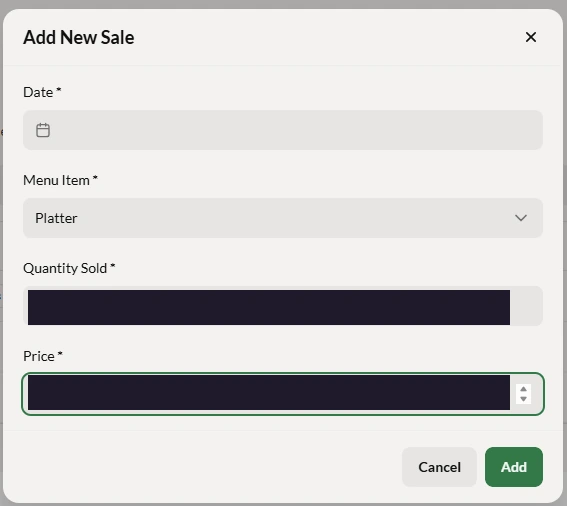
The client wanted restaurant staff to record dishes sold through a Softr interface and have Airtable ingredient stock adjusted according to recipe quantities. The backend was partially structured and Twilio was already connected to Pipedream, but the deduction and notification automations were not configured at the beginning.
Superb Digitals continued the technical implementation beyond the initial engagement.
What needed to change.
The client preferred dish-specific buttons with quantity entry instead of a long form. We discussed an alternative dropdown but approval was not established.
The client identified the daily sales table as the destination for submitted transactions. A successful button click would only be one step toward a correct stock movement.
A connected solution.
The intended architecture separated Softr sales entry, Airtable's daily sales and recipe/inventory records, and Pipedream's calculation and notification processing. Ingredient consumption should equal portions sold multiplied by the per-dish ingredient requirement. The later project completion has been confirmed by Superb Digitals, but no dated final workflow run or stock-before/after records are present in the source archive. Consequently, production deductions, Twilio delivery, duplicate protection and weekly reports require evidence before being claimed. Technology stack: Softr · Airtable · Pipedream · Twilio.
Implementation, step by step.
Existing client stack
The client already had Airtable tables partially configured and Twilio linked to Pipedream.
Sales-entry UX
The client wanted button-based dish selection with quantity entry, rather than a conventional long form.
Alternative proposal
The developer proposed a dropdown with numeric quantity; client requested visual proof and did not definitively approve a substitute.
Airtable table selection
The developer asked where sales belonged; the buyer identified the daily sales table.
Recipe deduction logic
The requested formula multiplies portions sold by per-dish ingredient consumption and updates current stock.
Alerts
SMS and email were requested when stock passed ingredient-specific restock thresholds; no completed test was documented.
Weekly report
A Sunday summary of dishes, quantities and low stock was included in scope; no successful report delivery was verified.
Delivery conflict
Proof boundary
Platform access and early interface discussion were documented, not a completed inventory platform.
Technical decisions, edge cases and validation
Recipes can use grams, millilitres or pieces while stock may be stored in different units. Conversions and the relation between recipes and stock records require explicit testing; their actual implementation is not established by the historic archive. A forwarded alert is only useful when both the underlying ingredient balance and its restock threshold are correct. The project required SMS and email but retained no accepted delivery proof from the original phase.
What We Delivered.
Softr sales entry, Airtable table design and Pipedream inventory workflow requirements were documented and refined.
Softr, Airtable and Pipedream restaurant sales-entry and inventory automation workflow development.
Technical lessons for comparable projects: Keep user-friendly dish entry distinct from inventory calculation.
Map each recipe ingredient and unit accurately before subtracting stock.
Use stable sale IDs to prevent duplicate deductions when runs retry.
Implementation Summary
- Softr, Airtable and Pipedream restaurant sales-entry and inventory automation workflow development.
Frequently Asked Questions.
What causes a stock deduction?
An eligible recorded dish sale tied to the dish recipe and quantity.
Was an individual-button UI required?
Yes. A dropdown alternative was discussed but not conclusively accepted in the initial record.
Were alerts tested in the original archive?
No successful Twilio/email end-to-end test is retained.
Want sales entries and inventory updates working together?
Tell us about your project and discuss the next steps with Superb Digitals.
Related client work.
 AI Automation
Hostfully & PriceLabs Integration
Two rental listings with different booking windows, connected pricing and practical stay-rule troubleshooting.
 AI Automation
24/7 Weather Monitoring & Smart Alert Automation
A six-phase weather automation project using Tempest, WeatherLink, IFTTT, Make.com and Apps Script for rain and storm alerts.
 AI Automation
Leonidas Labs — AI-Powered Quiz & Automated Report Generation
An AI-powered quiz funnel connecting Jotform, Make.com, OpenAI, Brevo, Stripe and Google Docs for personalized reports.