
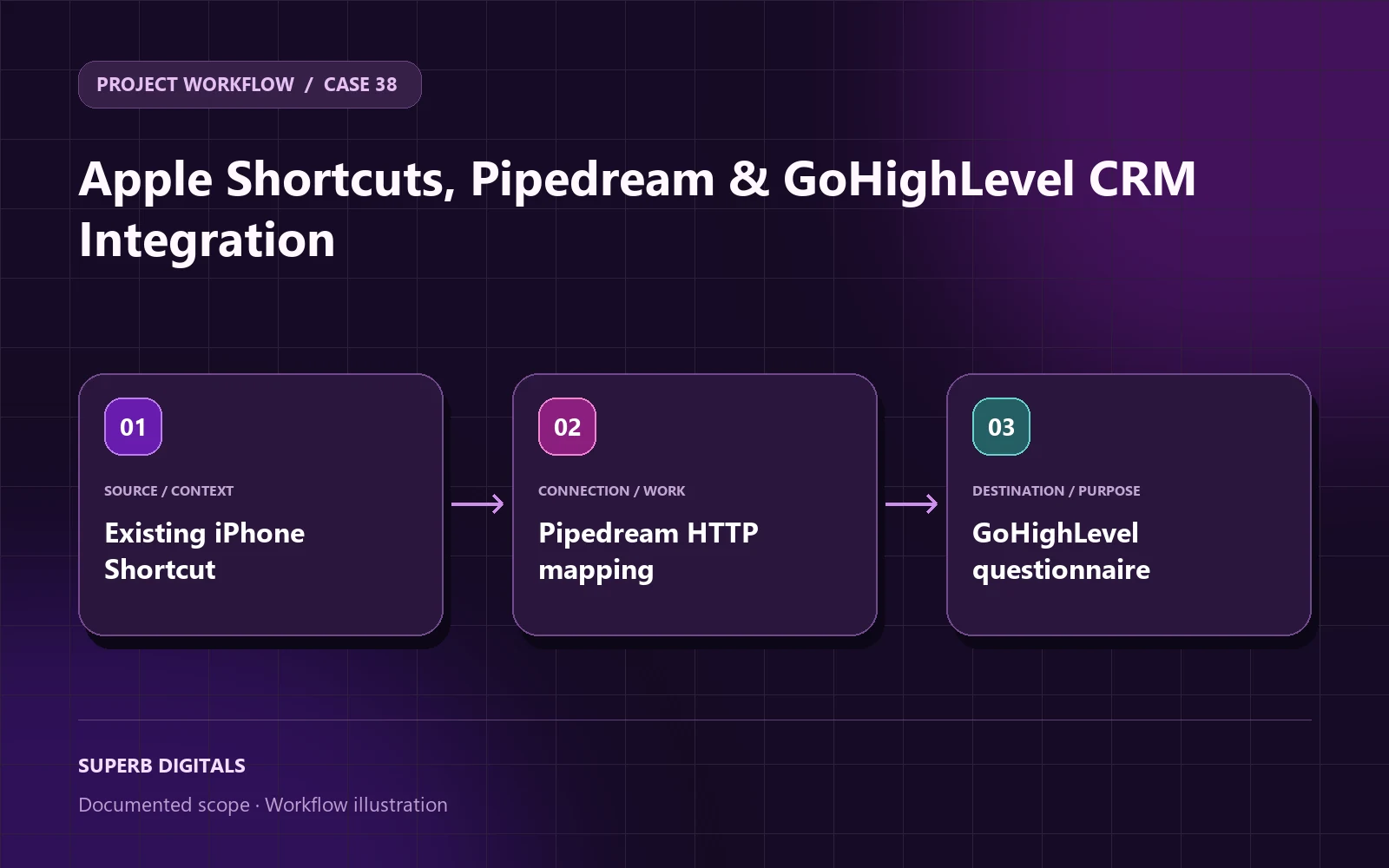
Apple Shortcuts, Pipedream & GoHighLevel CRM Integration
A mobile Shortcut-to-GHL contact and questionnaire workflow repaired through Pipedream HTTP and custom-field mapping.
Project overview.
A mobile Shortcut-to-GHL contact and questionnaire workflow repaired through Pipedream HTTP and custom-field mapping.

The principal platforms were Apple Shortcuts, Pipedream, GoHighLevel, HTTP APIs, JSON.
What needed to change.
The client already had an iPhone Shortcut collecting contact and questionnaire fields and a Pipedream trigger, but the data did not reliably reach GoHighLevel.
A connected solution.
Existing workflow assessment. The developer reviewed the Pipedream request and existing Apple Shortcut without claiming to have originally created the Shortcut.
Implementation, step by step.
CRM access
The client added access to the correct GoHighLevel sub-account.
HTTP 400 troubleshooting
Initial API attempts returned errors; retesting with different contact details helped narrow behaviour but did not conclusively prove a single root cause.
Missing questionnaire fields
A partially successful contact update showed that the custom questionnaire field list had not been fully included.
Field mapping
The developer mapped approved custom fields and excluded a question the client did not want saved in CRM.
Phone and names
Phone formatting and the exact firstName/lastName API property names required revision.
Undefined values
Pipedream mapping produced undefined for some fields; further corrections were reported and buyer-tested.
Associated email check
An associated email arrived in the spam folder; this was a test observation, not an email workflow necessarily built by the seller.
Client validation
The client approved the CRM integration work and later returned for a related business-card scanning project.
Validation and operating considerations
For this stage, the practical acceptance question is whether the intended output was visible in the receiving application—not merely whether a source event or intermediary request executed. The system design should identify the source of truth, preserve stable record IDs, handle missing data and avoid duplicate actions. Where a project involved financial payments, sensitive personal records, telephony, or automated publishing, the workflow also needs the permissions and safeguards appropriate to that specific domain. These are implementation recommendations, not undocumented historic deliverables.
What We Delivered.
The client tested and accepted the contact-transfer workflow.
CRM contact data transfer observed in tests.
Project Highlights
- No independent audit of every custom field for all future events.
- Original Shortcut development and email workflow creation were outside this order’s documented scope.

Project visuals.
 View image
Frequently Asked Questions.
Can Apple Shortcuts send data to GoHighLevel?
A Shortcut can submit structured information through an authorized webhook and downstream CRM API.
Why does Pipedream show undefined?
A mapping may reference a missing or incorrectly named value.
What causes GHL API 400 errors?
The receiving service rejected the submitted request; inspect response details and account rules.
Was the underlying scanner part of this project?
No. This was an existing questionnaire Shortcut, separate from the later business-card scanner.
What was the biggest integration consideration?
The source and destination needed compatible data, appropriate permissions and a clear interpretation of successful end-to-end processing.
How should failed actions be handled?
A production design should validate inputs, record an appropriate error and use retry or escalation logic where supported.
How can duplicate records or events be avoided?
Prefer stable identifiers and an explicit duplicate-handling policy rather than relying only on display names or repeated polling.
How should account credentials be protected?
Use role-based access, protected secret storage and rotate any credentials that have been exposed.
Can the integration be scaled automatically?
Scalability depends on provider plans, API limits, event volume, data quality and monitoring; this case does not establish an unlimited capacity.
Did the project produce a verified conversion increase?
No quantified conversion or revenue improvement is documented in the available evidence.
Need mobile data capture connected to GoHighLevel?
Tell us about your project and discuss the next steps with Superb Digitals.
Related client work.
 AI Automation
Hostfully & PriceLabs Integration
Two rental listings with different booking windows, connected pricing and practical stay-rule troubleshooting.
 AI Voice Agents
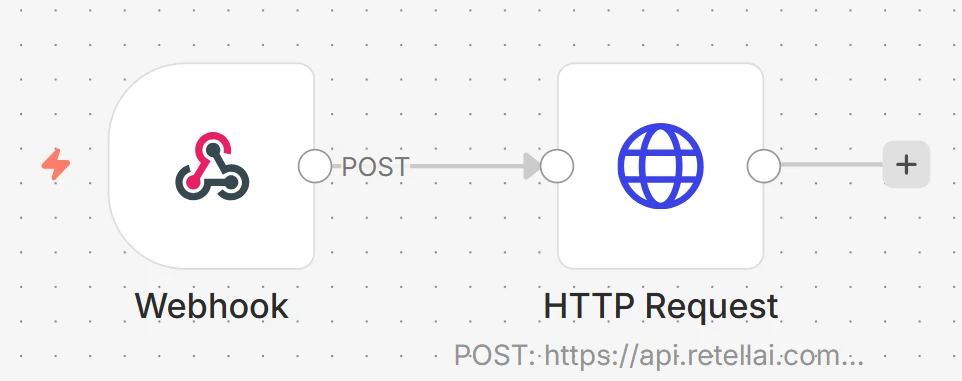
Retell AI + GoHighLevel Outbound Calling Automation
An AI outbound-calling integration connecting Retell AI, GoHighLevel and n8n for lead outreach, qualification and CRM handoff.
 AI Automation
24/7 Weather Monitoring & Smart Alert Automation
A six-phase weather automation project using Tempest, WeatherLink, IFTTT, Make.com and Apps Script for rain and storm alerts.