Medical Courier Marketing Funnels & Appointment Automation
An integrated marketing funnel for a medical courier service connecting ClickFunnels, ActiveCampaign, OnceHub and Make.com.
Project overview.
Building an Integrated Digital Marketing System for a Medical Courier Business
A business can have an excellent service, an established brand and several powerful marketing tools yet still struggle to turn interested prospects into meaningful conversations.
The problem is often not a lack of software.
It is that the different systems are not working together.
A visitor discovers the business through an advertisement, but the landing page does not guide them to the next step.
An appointment is booked, but the contact is not properly recorded in the CRM.
A marketing email is prepared, but the automation is not connected to the correct customer journey.
This was the challenge behind our work with AIMS, a business operating in the medical courier and healthcare logistics industry.
The company wanted to develop a digital marketing system targeting organizations that rely on specialized transportation services, including pharmaceutical businesses, hospitals and laboratories.
The client already had access to ClickFunnels, ActiveCampaign and OnceHub.
They also had marketing content, email sequences and promotional materials in development.
However, navigating the different platforms and creating a coordinated marketing process had become difficult.
Superb Digitals was engaged to support the technical implementation.
Our work involved ClickFunnels page development, custom lead-capture and assessment forms, appointment scheduling connections, ActiveCampaign contact management, Make.com automation and marketing workflow improvements.
The engagement later expanded into a separate project addressing automation errors and Facebook advertising readiness.
This case study demonstrates how Superb Digitals approaches multi-platform digital marketing infrastructure for a specialized B2B service business.
Client: AIMS

Industry: Medical Courier and Healthcare Logistics
Target market: Healthcare organizations and businesses requiring courier services
Project period: August–November 2025
Project type: Sales Funnel Development, CRM Integration and Marketing Automation
Landing-page platform: ClickFunnels
Email marketing and contact management: ActiveCampaign
Appointment scheduling: OnceHub
Workflow automation: Make.com
Custom development: HTML, CSS and custom web forms
Additional tools: GitHub, Vimeo, Facebook and LinkedIn
Engagement outcome: Completed funnel development and a subsequent automation/campaign review engagement, with some marketing activities remaining under the client’s management.
Understanding the Business and Its Marketing Goals
Medical courier services support businesses that need reliable transportation of healthcare-related items.
Potential customers can include laboratories, hospitals, clinics, pharmaceutical companies and other healthcare service providers.
For a medical logistics business, the marketing challenge is different from that of an ordinary retail store.
Prospective clients often need to understand the company’s service capabilities, responsiveness, operating procedures and suitability for particular transportation requirements.
They may not be ready to make an immediate purchase after visiting a website.
Instead, they may prefer to schedule a consultation, discuss their needs or complete an assessment.
AIMS wanted a digital marketing system built around this type of buyer journey.
The initial campaign plan divided its audience into three groups.
Pharmaceutical Organizations
The first audience included pharmaceutical-related businesses requiring courier and logistics support.
Marketing content for this group needed to address delivery coordination and the importance of dependable service.
Hospitals and Organ-Related Transportation Enquiries
The second audience involved hospitals and organizations interested in specialized, time-sensitive transportation.
This required careful messaging because healthcare transportation is a sensitive operational area.
The campaign needed to explain the company’s offering without making unsupported claims about regulatory approval, specialized handling capabilities or guaranteed delivery performance.
Laboratories and Clinics
The third audience included laboratories and clinics that may require the collection and transportation of specimens, supplies or other approved items.
The marketing approach focused on understanding the needs of these organizations and helping interested decision-makers begin a conversation.
Although the three groups operate within healthcare, they do not necessarily evaluate courier providers in the same way.
The funnel strategy therefore needed to distinguish between different customer motivations.
What needed to change.
Connecting Several Platforms Into One Customer Journey
The client already had the primary marketing tools.
ClickFunnels could provide landing pages.
ActiveCampaign could manage contacts and email workflows.
OnceHub could handle appointment scheduling.
However, operating these platforms individually was not enough.
The client wanted visitors to move through a coordinated process.
That required a clear answer to several questions:
Where should a prospect arrive after clicking an advertisement?
What information should be collected before scheduling?
How should the appointment be booked?
What happens to the contact information afterward?
How does ActiveCampaign know which audience the prospect belongs to?
Which email sequence should the prospect receive?
And how can the business distinguish an interested prospect from someone who has merely viewed a page?
The objective was to organize these steps into a practical digital marketing experience.
A connected solution.
Design the Funnel Around Customer Intent
We began by reviewing the client’s goals, existing tools and available marketing materials.
The project was not intended to replace everything the client had already prepared.
Instead, our task was to make better use of those resources.
The client had already invested in marketing software, email content and training.
We therefore concentrated on establishing a more coherent technical structure.
The planned system connected three main stages:
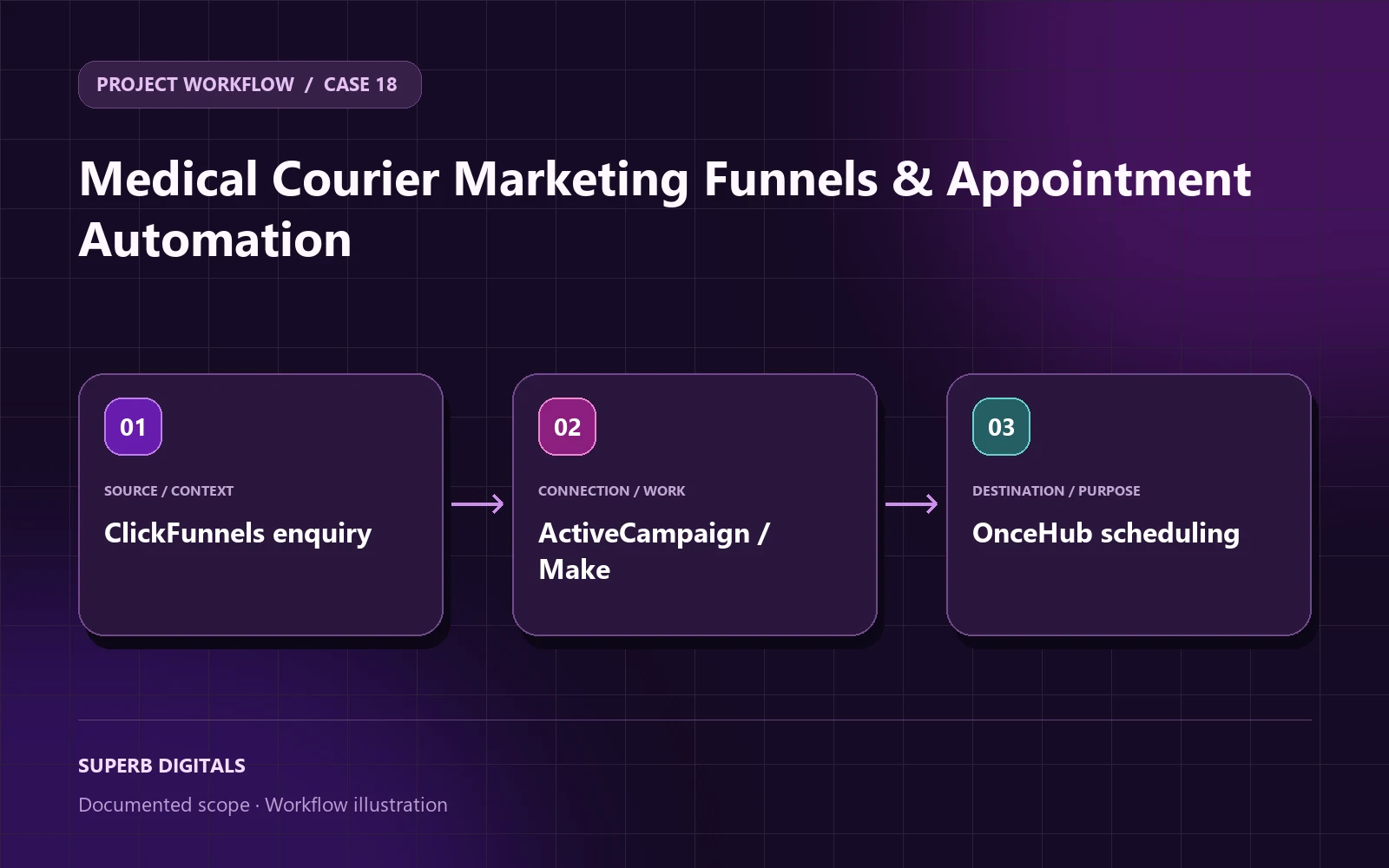
Lead Capture → Appointment Scheduling → Follow-Up and Assessment
Marketing content for different healthcare audiences could direct visitors into this process.
Once a visitor took the appropriate action, the connected systems needed to manage the next step.
This approach separated the role of each platform while keeping the overall journey connected.
Implementation, step by step.
Stage 1: Planning the Three Healthcare Audience Funnels
The original project brief called for three ClickFunnels funnel tracks.
These targeted pharmaceutical organizations, hospitals and organ-related transportation enquiries, and laboratories or clinics.
The client wanted to understand which types of healthcare organizations showed the greatest interest.
That made audience segmentation an important part of the project.
Why Segmentation Matters
If all leads enter one undifferentiated contact list, it becomes difficult to understand the different reasons they contacted the business.
A laboratory representative may have questions that differ from those of a pharmaceutical company.
The client wanted these audiences distinguished within the marketing system.
We therefore discussed contact tags and related automation logic in ActiveCampaign.
The proposed segmentation included categories for pharmaceutical organizations, hospitals and laboratories.
This structure would support more relevant follow-up and reporting when correctly applied.
The three audience categories formed the marketing plan.
The recorded implementation also involved a three-stage funnel journey. These are related concepts, but they are not the same: three intended audience tracks do not automatically establish three fully deployed advertising campaigns.
Stage 2: Developing the ClickFunnels Landing-Page Experience
ClickFunnels was the primary platform used to present the marketing offer.
We worked on landing pages that combined the client’s messaging, visual assets and lead-generation objectives.
The client supplied promotional images, branding materials and video content.
These resources needed to be incorporated into a consistent page design.
Building a Clear Landing-Page Structure
The funnel experience needed to introduce the business and encourage visitors to continue.
The work involved branded page layouts, video content, explanatory copy and calls to action.
The client reviewed the designs during development and requested changes to headings, buttons and images.
This feedback informed the final presentation.
Moving From Generic Buttons to Clear Actions
Calls to action are particularly important in a funnel.
A button should tell the visitor what will happen next.
During the engagement, we refined wording such as:
Book Appointment
Ready to Get Started
Click Here for Assessment Form
These actions were intended to make the visitor journey more understandable.
Rather than encouraging someone to click a vague button, the page indicated the next relevant step.
Incorporating the Brand’s Visual Identity
AIMS provided promotional materials for use across its funnel and social media presence.
We incorporated these materials into the page-development work to maintain brand consistency.
The client also supplied replacement imagery during revisions.
The objective was to ensure that visitors moving from promotional content to the landing page encountered a recognizable business identity.
Stage 3: Building the Three-Stage Lead and Appointment Journey
The project conversations identify three principal stages in the ClickFunnels experience.
Stage One: Opt-In and Contact Capture
The first stage introduced the marketing offer and collected relevant visitor information.
The purpose was to establish contact with a prospective customer before directing them through the next step.
Lead capture needed to be easy to understand, with clear form instructions and a logical action after submission.
Stage Two: Appointment Scheduling
The second stage directed visitors toward OnceHub to book an appointment.
OnceHub served as the appointment scheduling platform.
The recorded implementation used redirection from ClickFunnels to OnceHub and then back to the funnel.
This was a deliberate technical distinction from embedding the entire OnceHub calendar directly inside a ClickFunnels page.
The client later reviewed the difference and chose to retain the redirection approach.
Stage Three: Video and Assessment Experience
The final stage involved additional video content and an assessment form.
This allowed the business to provide more information and collect relevant details from a prospect.
The recorded funnel structure included a post-appointment page associated with the video and assessment experience.
These stages gave the client a more defined progression than a standalone contact page.
The resulting journey combined marketing information, contact collection, appointment scheduling and follow-up assessment.
Stage 4: Connecting OnceHub to ActiveCampaign Through Make.com
A key technical requirement was ensuring that appointment activity could inform contact management.
The client did not want appointment information isolated from the marketing system.
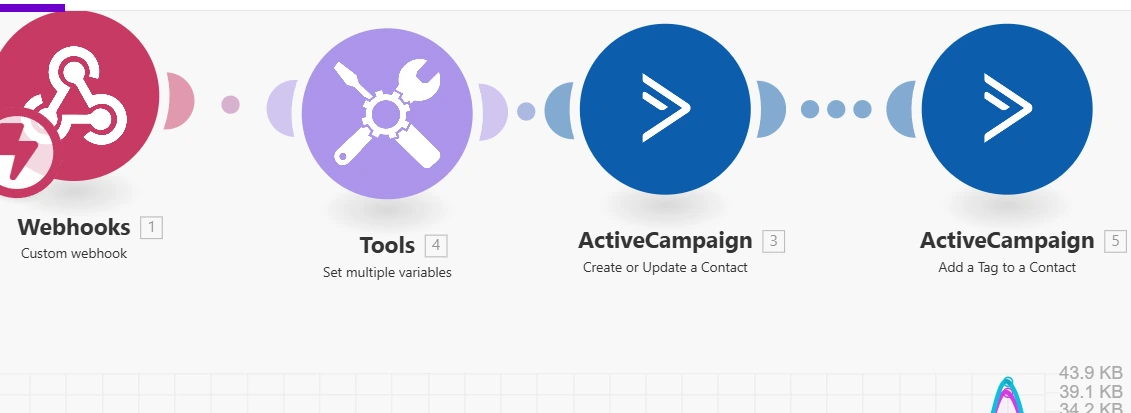
When a relevant OnceHub booking occurred, the intended workflow needed to create or update the associated contact inside ActiveCampaign.
We developed a Make.com automation for this process.
Why Make.com Was Introduced
The original project brief focused on ClickFunnels, ActiveCampaign and OnceHub.
During implementation, we recommended Make.com to support the required cross-platform automation.
Make.com provided flexibility for coordinating actions between the different services.
The client’s workflow required more than one simple transfer of information.
It involved contact data, appointment information and CRM tagging.
Make.com was selected as a suitable orchestration platform for this requirement.
The Booking-to-CRM Workflow
The implemented workflow was designed around the following process:
- A prospective customer enters the funnel.
- The visitor moves to the OnceHub appointment experience.
- A relevant booking event becomes available to the automation.
- Make.com processes the associated information.
- ActiveCampaign creates or updates the contact.
- Relevant tagging or follow-up logic can use the stored contact information.
During development, we reported completing the automation for creating or updating contacts after appointments.
The project also included tagging logic associated with booking activity.
This provided a technical connection between appointment scheduling and CRM contact management.
Why Contact Matching Matters
Marketing systems can create unnecessary confusion when the same person appears multiple times.
A booking-to-CRM integration should therefore distinguish between a new contact and an existing contact wherever the supported workflow allows.
The agreed implementation included create-or-update behaviour.
This was relevant to keeping the appointment information associated with the correct prospect.
Stage 5: Working on ActiveCampaign Email Automation
The client already had email marketing content in development.
The original request referred to a five-day email sequence.
As the engagement progressed, the conversations also referred to a seven-day email automation and a separate three-day awareness campaign.
These were different marketing assets with different intended roles.
Our work involved reviewing email templates, improving presentation and discussing the appropriate automation logic.
Email Branding and Presentation
Some email templates contained placeholders or inconsistent presentation.
We worked on refining selected templates and incorporating the client’s available video content.
The aim was to make the emails feel consistent with the funnel rather than separate, unrelated marketing communications.
Distinguishing Different Email Sequences
The client wanted the three-day awareness campaign and the seven-day email sequence to remain separate.
During a later review, we identified a trigger relationship that appeared to connect those two workflows.
We discussed the issue and the need to distinguish their purposes.
This mattered because overlapping triggers could cause contacts to receive messages that did not correspond to the intended journey.
Conditional Logic and Contact Tags
The implementation included work on conditional logic associated with the seven-day email automation.
The client also wanted tags that would help distinguish the different healthcare audience segments.
The objective was to support more relevant communication and easier review of the contact database.
However, the available records do not independently confirm that every planned email, tag and segment was fully tested in a live campaign.
Some email content remained subject to client review, and the client continued preparing additional marketing materials.
Stage 6: Developing a Custom Assessment Form
Another important part of the engagement involved a more detailed assessment experience.
The client had prepared questions and related form information.
The goal was to present this material in a professional, usable format connected to the funnel.
We worked on a custom form implementation and associated source code.
The development records refer to using GitHub to host or manage the form source.
The form was then incorporated into the ClickFunnels experience.
Why a Custom Form Was Considered
The client wanted an assessment layout that met specific presentation and interaction requirements.
A basic contact form was not necessarily sufficient.
The custom implementation provided greater control over the visible structure and user experience.
The resulting form was intended to support the lead qualification process after a visitor progressed through the funnel.
Connecting the Assessment to the Marketing Process
A form is most useful when its information can support the next business action.
The client wanted assessment information to be available through the marketing environment.
Our work therefore included reviewing how the form related to ActiveCampaign and the broader funnel journey.
The conversations establish the custom form development and embedding work.
They do not independently verify every possible downstream data-processing, reporting or storage behaviour.
Stage 7: Adding Video to the Funnel and Email Experience
The client wanted to use video content as part of the marketing journey.
The project incorporated Vimeo-hosted video content into the funnel and selected email templates.
Why Video Was Relevant
Medical courier services are specialized.
Potential customers may need more explanation than a short advertising headline can provide.
Video can help a business explain its services, approach and value proposition.
The client wanted this content integrated into the funnel rather than presented as unrelated external material.
Connecting Video to the Next Action
The video content was paired with calls to action.
These encouraged visitors to continue through the appointment or assessment process.
The combination of explanatory content and a defined next step helped create a more structured user experience.
The client reviewed the funnel and expressed satisfaction with its visual presentation.
Additional refinements were subsequently requested and incorporated during development.
Stage 8: Diagnosing Make.com Workflow Errors
The integration work was not free from technical challenges.
During September 2025, the client reported that Make.com had encountered errors affecting the opt-in workflow.
We investigated the reported behaviour.
One issue involved an expected email value that was missing from information received by the automation.
This caused problems with downstream processing.
We adjusted the relevant logic and reported that the workflow was functioning again.
This was a practical example of a common automation problem.
A connection between two platforms may appear correct, but a missing required field can prevent the receiving application from completing its action.
The automation needs to account for the structure of the information it receives.
The issue also demonstrated why funnel development requires more than simply connecting application accounts.
Data mapping and error handling are essential.
Stage 9: Reviewing Authentication and Integration Reliability
The client returned in October 2025 after encountering additional workflow problems.
During the new diagnostic work, we identified an ActiveCampaign authentication issue affecting the Make.com connection.
This required reviewing the authorization between the two platforms.
Why Authentication Errors Matter
Automations depend on valid account connections.
When credentials change, permissions are modified or a connection becomes invalid, the workflow may stop performing its intended actions.
A funnel can continue displaying pages correctly even when the automation behind it is experiencing errors.
That can make the problem difficult for a business owner to recognize.
We reviewed the connection and worked with the client on reauthentication.
The follow-up engagement also involved checking the related email workflow and assessment-form requirements.
This demonstrates experience working through integration maintenance rather than only initial setup.
Reviewing the Email Automation Structure
The subsequent review identified that the three-day awareness campaign and the seven-day email sequence had been associated with an overlapping trigger arrangement.
We discussed the need to separate them.
The review also considered the presentation of email templates and whether the messages matched the business’s branding.
The client clarified which sequence was intended to connect to the ClickFunnels landing-page process.
This helped establish a clearer distinction between the two email campaigns.
Stage 10: Reviewing the Facebook Advertising Connection
The second order also included Facebook campaign setup and validation.
The client wanted to advertise the medical courier services and direct interested people into the funnel.
The work therefore required reviewing how the advertising campaign connected to the ClickFunnels page.
Checking the Funnel Destination
During the review, we identified a missing or unsuitable funnel destination in the campaign configuration.
A Facebook advertisement needs a destination that supports the intended visitor action.
If the link is missing, a potential customer cannot follow the expected journey.
We worked with the client to correct the funnel link during a review session.
Reviewing Campaign Readiness
The work also included discussing the campaign setup, targeting and creative materials.
We recommended testing suitable variations of advertising content and reviewing which messages attracted relevant interest.
This was advisory and configuration-review work.
The client ultimately assigned the ongoing Facebook advertising responsibilities to a family member.
Therefore, this case study does not claim that Superb Digitals independently launched, managed or optimized a live paid campaign to measurable profitability.
The confirmed contribution was the campaign review, funnel-link correction and related technical recommendations.
Stage 11: Managing the Project Through Client Feedback
A major feature of this engagement was ongoing collaboration.
The client had a specific vision for how the marketing process should work.
They also wanted to understand the tools they were using.
During implementation, the client supplied content, images and feedback about the page design.
The client also requested written progress updates, review calls and explanations of how the different platforms were connected.
This influenced the development process.
The project required not only technical implementation but also clarification of requirements and communication about what had been completed.
Some elements depended on the client’s marketing coach, supplied email content and account permissions.
Those dependencies affected the development schedule.

What We Delivered.
A Multi-Platform Marketing System and Repeat Client Engagement
The second was completed in November 2025.
Documented Outcomes
ClickFunnels page development
The work included branded funnel pages, lead-capture experiences, video sections and appointment-related navigation.
Three-stage customer journey
The recorded implementation included opt-in, scheduling and post-appointment assessment stages.
Healthcare audience planning
The client developed the campaign around pharmaceutical organizations, hospitals and organ-related enquiries, and laboratories or clinics.
OnceHub appointment connection
The visitor journey used OnceHub scheduling with redirection back to the funnel.
Make.com integration
The work included a booking-related automation to create or update ActiveCampaign contact records.
ActiveCampaign automation work
The engagement included email template adjustments, conditional logic, contact-tagging discussions and workflow review.
Custom assessment-form development
A custom assessment form and related source code were prepared and integrated into the funnel experience.
Technical troubleshooting
The work included correcting a Make.com data issue, reviewing authentication and examining overlapping email automation triggers.
Facebook campaign review
The follow-up engagement included checking the campaign’s funnel destination and providing configuration recommendations.
The same client reviewed both completed engagements positively.
Outcomes Not Independently Verified
The available order records do not establish:
- A specific number of qualified medical courier leads
- A measured increase in booked consultations
- A verified improvement in email open or click-through rates
- A confirmed advertising return on investment
- A fully launched and profitable Facebook ad campaign
- Three independently published and performing audience campaigns
- Permanent resolution of every possible automation failure
- Complete live testing of every email sequence
- A measurable increase in courier contracts or revenue
These outcomes would require analytics, campaign reporting, CRM records or other client-confirmed data.
The documented value lies in the technical implementation, delivered funnel assets, follow-up review work and repeat client satisfaction.
Client Feedback
The client praised the development work, patience and ability to translate the business vision into practical funnel solutions.
The review also expressed interest in continuing the professional relationship.
Following the second engagement, the client again awarded five stars.
The client particularly highlighted professionalism, communication and responsiveness when additional help was needed.
The two reviews provide credible evidence of a returning client who valued the collaboration across both implementation and troubleshooting work.
Experience, Expertise, Authoritativeness and Trustworthiness
Experience: Working on a Real Multi-Platform Marketing Project
This project involved an actual business using several marketing platforms.
The work was not limited to a generic funnel template.
It included client-specific content, audience planning, custom form development, scheduling, CRM records and automation troubleshooting.
The follow-up order also demonstrates practical experience responding to integration problems after the initial development phase.
Expertise: Funnel Architecture and CRM Automation
The project required understanding the relationship between landing pages, contact records, appointment scheduling and email automation.
It involved connecting ClickFunnels, ActiveCampaign, OnceHub and Make.com around a defined customer journey.
The work also included custom forms, conditional logic, data mapping and troubleshooting.
These are important technical components of marketing automation.
Authoritativeness: Verified Client Engagement and Reviews
The client’s return for additional work demonstrates an ongoing relationship rather than a single isolated request.
Trustworthiness: Accurate Scope and Transparent Outcomes
The project records include both positive feedback and technical issues.
The automation required corrections, the email campaigns needed further review, and the advertising work changed when the client reassigned responsibilities.
Those facts are part of the project’s history.
The case study does not treat the existence of a funnel as proof of sales results.
It distinguishes delivered technical work from business outcomes that would require additional measurement.
This approach helps prospective clients evaluate the experience without relying on unsupported performance claims.
What This Project Demonstrates About Superb Digitals
ClickFunnels Development
Experience building branded, multi-stage marketing pages and connecting them to customer actions.
ActiveCampaign Automation
Experience working with contact records, email templates, tagging requirements and marketing workflow logic.
OnceHub Appointment Scheduling
Experience incorporating appointment scheduling into a wider lead-generation journey.
Make.com Integration
Experience connecting applications, processing information and troubleshooting workflow errors.
Custom Form Development
Experience creating more flexible assessment experiences where basic forms do not meet the project requirements.
Healthcare Logistics Marketing
Experience developing digital marketing infrastructure for a specialized B2B transportation business.
Campaign and Conversion Pathway Review
Experience checking the connection between advertisements, landing pages and downstream marketing actions.
Ongoing Technical Support
Experience returning to an existing system, investigating reported problems and implementing further improvements.
Important Lessons From the Project
A Funnel Is More Than a Landing Page
A visually appealing landing page is only one component of a marketing system.
Lead capture, scheduling, email communication and CRM updates need to be designed together.
Integration Errors Can Disrupt an Otherwise Functional Website
Visitors may still be able to view the funnel even when a background automation has stopped processing information.
Testing should include the connected systems, not only the visible pages.
Audience Segmentation Needs a Clear Purpose
Tags and email automation are useful when they reflect meaningful customer differences.
The business should know why it is separating its audiences and what it intends to do with that information.
Authentication Requires Ongoing Maintenance
Marketing integrations can fail when permissions or account connections change.
A reliable system needs appropriate monitoring, ownership and support arrangements.
Marketing Results Must Be Measured
The delivery of a funnel does not automatically prove that the business will generate more leads or revenue.
Conversion performance depends on traffic quality, messaging, offers, follow-up and the customer experience.
Project visuals.
 View image
Frequently Asked Questions.
Can ClickFunnels integrate with ActiveCampaign?
Yes. The platforms can be connected through supported integration methods and automation tools. The exact configuration depends on the required lead data, campaigns and customer journey.
Can OnceHub appointment bookings update ActiveCampaign contacts?
Yes. An appropriate workflow can use supported booking information to create or update CRM contacts. The integration needs reliable contact matching and valid account permissions.
What does Make.com do in a marketing funnel?
Make.com can coordinate actions between connected applications, such as processing booking information, updating contacts and triggering supported workflow steps.
Can a medical courier business use marketing funnels?
Yes. A marketing funnel can help a medical courier business explain its services, capture enquiries and guide prospective business customers toward consultations or assessments.
Why would a business create separate funnels for different healthcare audiences?
Different healthcare organizations may have different logistics requirements. Audience-specific marketing can help address those needs more clearly.
Can ActiveCampaign send automated follow-up emails?
Yes. ActiveCampaign supports marketing automations based on configured conditions and triggers. The messages and workflows need to be designed, activated and tested.
Is it better to embed an appointment calendar or redirect visitors to a booking page?
Both approaches can be appropriate. An embedded calendar keeps scheduling within the landing-page experience, while redirection may be simpler to implement or maintain. The choice depends on the desired workflow.
Why does a Make.com automation sometimes stop working?
Possible causes include expired connections, incorrect permissions, missing data, unsupported response values, usage limits or changes in connected platforms.
Can custom assessment forms be connected to a marketing funnel?
Yes. Custom forms can be integrated into a funnel where the hosting, submission handling and data-processing requirements are properly supported.
Does a ClickFunnels integration guarantee more leads?
No. A properly connected funnel supports the customer journey, but the number and quality of leads depend on the marketing campaign, offer, traffic and audience.
Can Facebook advertisements direct users into ClickFunnels?
Yes. Advertisements can use a suitable funnel page as their destination, subject to advertising policies and correct campaign configuration.
How do you evaluate a marketing funnel’s performance?
Relevant measurements may include landing-page visits, form submissions, appointment bookings, contact quality, email engagement and confirmed sales outcomes.
Can Superb Digitals improve an existing funnel instead of rebuilding it?
Yes. Superb Digitals works on funnel improvements, CRM integration, workflow troubleshooting, appointment scheduling connections and technical automation support.
Need a Marketing Funnel That Connects Your Business Systems?
A successful marketing process requires more than several disconnected software subscriptions.
Your landing pages, scheduling system, CRM and follow-up communication should support the customer journey you want to create.
At Superb Digitals, we help businesses connect those systems through practical development and automation.
Our services include ClickFunnels development, ActiveCampaign setup, OnceHub scheduling integration, Make.com workflows, custom lead-capture forms, CRM automation and marketing funnel troubleshooting.
Whether you’re developing a new funnel or trying to resolve problems in an existing one, we can help identify the technical requirements and build a more coordinated process.
Let’s discuss your marketing automation project.
Visit https://superbdigitals.com/ to explore our services and contact the team.
Superb Digitals — Web Development, CRM & AI Automation Solutions.
Need a marketing funnel connected to appointment booking?
Tell us about your project and discuss the next steps with Superb Digitals.
Related client work.
 AI Automation
Hostfully & PriceLabs Integration
Two rental listings with different booking windows, connected pricing and practical stay-rule troubleshooting.
 AI Voice Agents
Retell AI + GoHighLevel Outbound Calling Automation
An AI outbound-calling integration connecting Retell AI, GoHighLevel and n8n for lead outreach, qualification and CRM handoff.
 AI Automation
24/7 Weather Monitoring & Smart Alert Automation
A six-phase weather automation project using Tempest, WeatherLink, IFTTT, Make.com and Apps Script for rain and storm alerts.