
Nova AI — GoHighLevel + Vapi AI Lead Automation
A solar lead automation project connecting GoHighLevel, Vapi AI and Make.com with outbound calling, qualification and scheduling.
Project overview.
Connecting AI-Powered Phone Conversations to a Real Solar Sales Process
An AI voice agent can answer questions, speak naturally and make phone calls. But for a business, these capabilities are only useful when they connect to a defined outcome.
Who should the AI call?
What should it know about each prospect before the conversation starts?
How should it determine whether someone is qualified?
Can it schedule an appointment without creating calendar conflicts?
What happens to the information collected during the conversation?
And how will the sales representative prepare for the appointment?
These were the central questions behind Nova AI, a custom solar appointment-setting system developed for a client associated with The Solar District.
The client wanted an AI-powered assistant capable of engaging solar prospects, gathering qualification information, scheduling consultations and coordinating follow-up activities.
The planned system went beyond ordinary conversational AI.
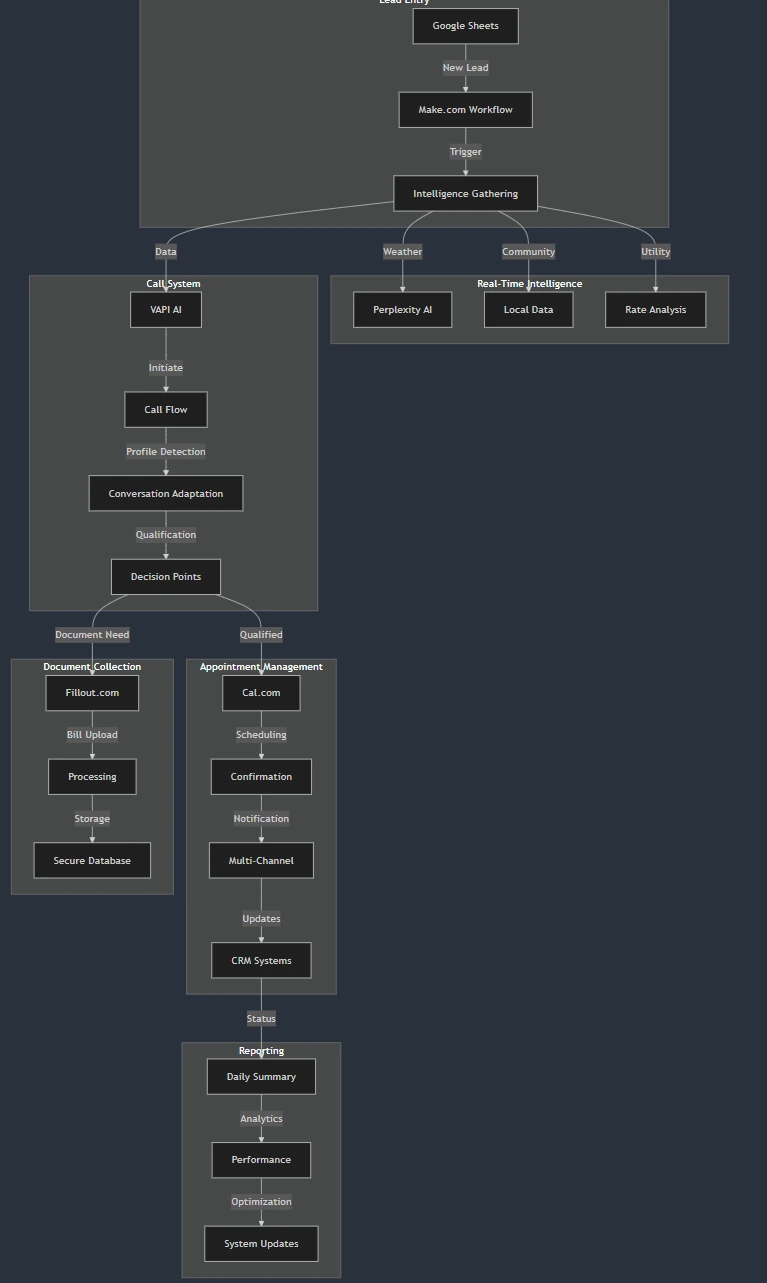
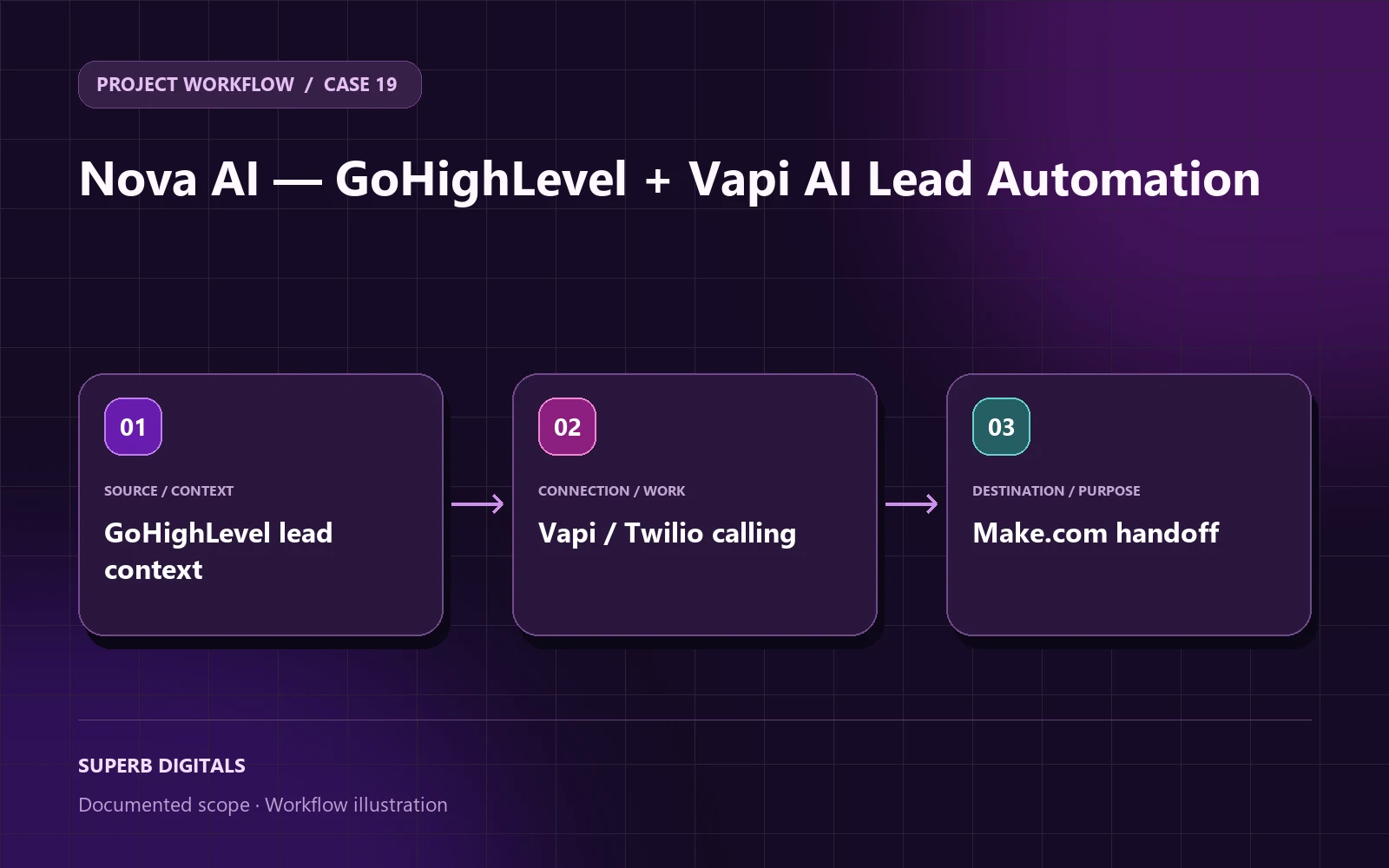
It needed to connect several independent platforms: GoHighLevel for lead management, Vapi AI for conversations, Perplexity AI for local research, Make.com for workflow orchestration, Twilio for calling infrastructure, Cal.com for appointments and Fillout for document collection.
Superb Digitals was engaged to help build those connections and turn the client’s AI assistant concept into an operational automation workflow.
The project involved actual call testing, account authentication problems, integration errors, appointment synchronization, CRM tracking, AI prompt revisions and API rate-limit management.
This case study explores the technical work, project challenges and business automation principles demonstrated during the engagement.
Client: Royal S — The Solar District project
Industry: Residential Solar Energy and Sales Lead Generation
AI assistant: Nova AI
Project period: January–May 2025
Project type: AI Voice Agent and CRM Automation Integration
Voice AI platform: Vapi AI
CRM platform: GoHighLevel
Automation platform: Make.com
Research tools: Perplexity AI and OpenAI API
Calling infrastructure: Twilio
Scheduling platform: Cal.com
Document collection: Fillout
Additional workflow components: CRM tags, pipeline tracking, call summaries and planned reporting
What needed to change.
Turning Solar Leads Into Qualified Appointments
Solar sales often involve several steps between identifying a potential customer and scheduling a productive consultation.
A lead may have expressed interest in solar energy previously, but that does not necessarily mean they are ready for an appointment.
The business may need to confirm whether the person owns the property, understands the purpose of the call, has relevant energy concerns and wants to learn more.
The sales team may also need information about the property, electricity usage, motivations and other factors relevant to the proposed consultation.
The client wanted Nova AI to help with these early-stage interactions.
The assistant would conduct outbound conversations with prospects already available through the business’s lead-management system.
Its responsibilities were intended to include introducing the company, assessing potential interest and collecting information that could help the sales team.
When appropriate, the system would move the prospect toward an appointment.
The challenge was connecting the different technical components so information could move through the process without unnecessary manual intervention.
A connected solution.
The Original Workflow Requirements
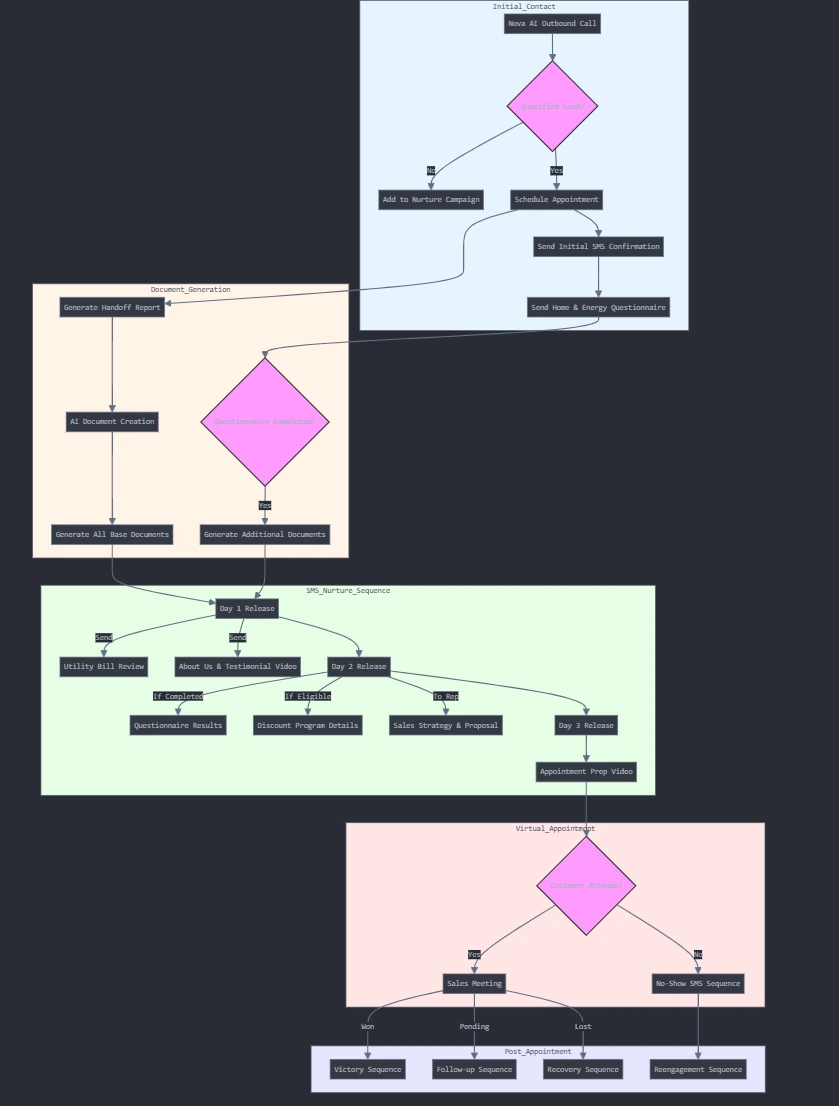
During project planning, the client identified a specific sequence of activities.
Local Market Research
Before contacting a prospect, the automation would retrieve relevant local information that could help personalize the conversation.
Outbound AI Calling
The calling workflow would initiate a voice conversation using the Vapi AI assistant.
Lead Qualification
Nova would ask questions designed to assess the prospect’s circumstances and potential interest in solar energy services.
Appointment Scheduling
When a suitable prospect agreed to an appointment, the system would use the connected scheduling infrastructure.
Utility Bill Submission
The client wanted a way to request a utility bill as part of the qualification and preparation process.
Post-Call Handoff Report
The planned report would summarize information useful to the assigned sales representative.
CRM Updates
GoHighLevel would serve as the main system for contact records, call status and related sales activity.
Follow-Up Communication
The broader design included SMS follow-ups and appointment-related communication.
These requirements defined an ambitious workflow involving several separate applications.
Implementation, step by step.
Stage 1: Reviewing the Existing AI Assistant and Project Documentation
The client already had a concept for Nova AI.
They had prepared conversation instructions, a calling list and example documents outlining the desired customer journey.
Rather than starting from a blank assistant, the work involved reviewing the existing materials and identifying what was required to connect the assistant to the wider business process.
The client provided examples of the intended appointment-setting behaviour and the report that the sales representative would eventually receive.
These materials helped define the difference between the voice conversation and the supporting automation.
The voice assistant was responsible for interacting with the prospect.
The automation system needed to manage the information and actions associated with that interaction.
We reviewed the requirements and discussed the proposed implementation before the order began.
Stage 2: Designing the Multi-Platform Automation Architecture
The project required several applications to work together.
Each had a different responsibility.
GoHighLevel: Lead and CRM Management
GoHighLevel was the primary environment for customer information and sales workflow activity.
It was used to manage contact information, tags and pipeline tracking.
Vapi AI: Voice Conversations
Vapi hosted the Nova assistant and supported the outbound AI calling functionality.
The voice agent’s instructions determined how it approached conversations and interacted with available functions.
Make.com: Workflow Orchestration
Make.com coordinated the data moving between the connected services.
This included research-related steps, call initiation and downstream processing.
Perplexity AI: Local Research
Perplexity was introduced to retrieve information intended to support more relevant conversations.
OpenAI API: Structured Information Processing
OpenAI API functionality was considered and used during development for organizing research information into a more structured form.
Twilio: Calling Infrastructure
Twilio was involved in phone-number provisioning, calling permissions and the connection to Vapi.
Cal.com: Appointment Scheduling
Cal.com provided the scheduling environment used in the client’s appointment workflow.
Fillout: Document Collection
Fillout hosted the utility-bill submission experience associated with the customer’s next steps.
The challenge was not simply having accounts with these services.
The automation needed to exchange information at the appropriate point in the customer journey.
Stage 3: Building the Lead Research Workflow
The client wanted Nova to have relevant context before initiating a conversation.
The planned process included local market research associated with the prospect.
Perplexity AI was used for research retrieval.
However, the raw results were not necessarily structured in a format suitable for every downstream automation action.
We therefore worked on an approach that combined research retrieval with structured information processing.
The aim was to transform useful research information into fields that other parts of the workflow could interpret.
This was important because an AI calling system should not rely on large, unorganized blocks of information when a more precise set of variables is required.
A Technical Challenge: Research API Credits
During implementation, the client encountered API usage and billing limitations.
The project required investigating which services had the necessary credits available.
An important distinction emerged between a ChatGPT subscription and OpenAI API billing.
The client initially believed that upgrading ChatGPT would address the integration problem.
However, the automation depended on API access, which has separate usage and billing requirements.
After reviewing the issue, the client made the necessary account changes.
This part of the project illustrates a common integration challenge: having access to an AI product does not automatically mean that the corresponding API has sufficient credit or permissions.
What We Delivered.
An AI Calling Workflow Tested With Real Leads
Documented Outcomes
Vapi AI calling integration
The client progressed from configuration difficulties to real outbound calling tests using the Nova assistant.
Make.com workflow development
The automation coordinated research, calling and related downstream processes.
GoHighLevel CRM configuration
The project included tags and pipeline tracking for call outcomes and related contact activity.
Cal.com scheduling integration
The work addressed appointment creation and synchronization with GoHighLevel.
Twilio calling troubleshooting
The engagement included account configuration, number import, authentication and calling-limit issues.
Utility-bill submission workflow
The development included a form-identification improvement and CRM tagging for document submissions.
AI research processing
The project used Perplexity and OpenAI API functionality while addressing billing and usage limitations.
Real call analysis
Actual conversations were reviewed to identify improvements to Nova’s script and business logic.
Lead-processing adjustments
The project included changes to outbound pacing in response to API and concurrency limitations.
Client satisfaction
Outcomes Not Independently Established
The records do not verify:
- A specific number of qualified solar leads
- A confirmed number of booked and attended appointments
- A measurable conversion rate
- Revenue from installed solar projects
- A completed 3,000-contact campaign
- A fully operational advanced AI handoff-report generator
- A complete AI-generated proposal and document-production system
- Continuous production uptime after project delivery
- Full telemarketing compliance certification
These outcomes require separate evidence from the calling platform, CRM, calendars and business reporting systems.
The documented achievement is the development and testing of a multi-platform AI calling and CRM integration.
Client Feedback
Following completion, the client awarded the project five stars.
The client praised the technical knowledge, communication and attention to detail demonstrated during the engagement.
The client also expressed interest in ordering additional services.
That feedback is an important part of the project’s evidence.
It reflects satisfaction with the delivered work despite the extended development process and the technical difficulties encountered along the way.
What This Project Demonstrates About Superb Digitals
AI Voice Agent Integration
The engagement demonstrates experience connecting conversational AI to business operations.
It involved the assistant’s instructions, calling infrastructure, data collection and downstream automation.
GoHighLevel CRM Automation
The project required working with contact records, tags, pipeline stages and appointment-related information.
This is directly relevant to businesses using GoHighLevel as their primary CRM.
Make.com Workflow Engineering
The implementation used Make.com to coordinate multiple external platforms.
It also involved troubleshooting authentication failures, API responses and rate limitations.
AI-Assisted Lead Research
The project introduced local research before calling and addressed how that information could be structured for the automation.
Appointment Scheduling Integration
The engagement connected Cal.com with the wider CRM workflow.
It required attention to event types, account permissions and calendar synchronization.
Twilio and Telephony Troubleshooting
The work included practical issues around phone-number import, calling restrictions, account authentication and service availability.
CRM Reporting and Qualification Logic
The project involved distinguishing call status from more meaningful sales outcomes.
It also included reviewing how actual conversations should influence CRM updates.
AI Agent Testing and Improvement
The client and developer reviewed live conversations and identified opportunities to improve the assistant’s instructions.
This demonstrates experience with the iterative work required to improve AI voice systems.
API Usage and Capacity Planning
The project involved managing research API limits, structured-data processing requirements and voice-calling concurrency.
These are important considerations for any automation expected to handle a larger contact list.
Why This Project Matters for Businesses Exploring AI Employees
Many organizations are interested in AI employees because they want to reduce repetitive work.
However, an AI voice agent should not be treated as a complete business solution by itself.
It needs reliable information, clear instructions and appropriate access to business systems.
The calling workflow must know which contacts to engage.
The conversation should follow an appropriate and transparent process.
The CRM needs to capture relevant outcomes.
Appointments must be recorded correctly.
And the business should be able to review what happened.
The Nova AI project illustrates the complexity of making these components work together.
It also demonstrates why technical integration, testing and ongoing refinement are essential.
Responsible AI Calling and Data Handling
AI-powered outbound calling must be implemented within applicable legal and platform requirements.
Businesses should verify relevant consent, calling permissions, opt-out procedures and telemarketing restrictions before operating live campaigns.
They should also handle call transcripts, contact information and uploaded documents securely.
A technically functioning automation does not establish regulatory compliance.
For this project, the available records do not include an independently verified compliance audit.
Any future deployment should consider the rules governing the location and audience being contacted.
Project visuals.
 View image
Frequently Asked Questions.
Can Vapi AI integrate with GoHighLevel?
Yes. Vapi AI and GoHighLevel can be connected through supported APIs, webhooks and automation platforms such as Make.com. The exact architecture depends on the desired calling workflow and data exchange.
What can an AI voice agent do for a solar company?
An appropriately configured AI voice agent can support initial enquiries, qualification conversations, appointment-related workflows and the collection of information needed for sales follow-up.
Can GoHighLevel trigger an AI outbound call?
GoHighLevel workflows can initiate supported automation actions and integrations. A connected voice platform can then handle calling, subject to its capabilities and applicable communication requirements.
Why use Make.com with Vapi AI?
Make.com can coordinate data between the CRM, the voice platform and other services. It is useful when the workflow requires multiple API connections, conditional logic or data transformations.
Can Perplexity AI be used for automated lead research?
Perplexity’s supported API capabilities can be used to retrieve research information. The resulting data should be validated and used responsibly, particularly when personalizing customer conversations.
Can an AI voice agent book appointments through Cal.com?
A suitable integration can connect an AI calling workflow to Cal.com. Availability, contact details, event types and booking results need to be handled correctly.
Can Cal.com appointments appear in GoHighLevel?
Yes. Supported API or workflow integrations can transfer appointment information between systems. The implementation needs to account for calendar identifiers, time zones and duplicate bookings.
Can AI voice agents collect documents from prospects?
They can support a process that directs users to an approved document-submission form. Sensitive documents should be collected through an appropriate secure system rather than treated as ordinary chat information.
What is an AI sales handoff report?
A sales handoff report summarizes useful information collected during a prospect interaction. It can include qualification details, stated concerns, appointment information and relevant follow-up requirements.
Why do AI outbound calling campaigns encounter concurrency errors?
Calling platforms limit how many conversations an account can handle simultaneously. If new calls are initiated while available capacity is occupied, additional requests may fail or be delayed.
What is the difference between an answered call and a qualified lead?
An answered call means the contact responded to the phone call. A qualified lead meets the business’s defined criteria for further sales engagement. The two outcomes should be measured separately.
Can GoHighLevel track unsuccessful AI calls?
Yes. With a suitable integration, call outcomes can be represented through contact fields, tags, opportunities or other supported CRM records.
Does an AI voice agent automatically improve after every call?
No. Improvements generally require appropriate review, updated instructions, validated data, supported learning mechanisms or changes to the workflow. Recording conversations alone does not guarantee that the assistant improves.
Does AI calling guarantee appointments or sales?
No. Results depend on contact quality, audience fit, communication practices, the offer, conversation quality and follow-up.
Can Superb Digitals help integrate an existing Vapi assistant?
Yes. Superb Digitals works on AI voice integration, GoHighLevel automation, Make.com workflows, APIs, scheduling connections and custom CRM processes.
Need an AI Voice Agent Connected to Your CRM?
A useful AI voice agent should do more than speak naturally.
It should fit into the way your business manages leads, books appointments and follows up with customers.
At Superb Digitals, we help businesses develop and integrate AI-powered automation around their operational requirements.
Our services include:
- Vapi AI voice agent integration
- Retell AI automation
- GoHighLevel CRM workflows
- AI-assisted lead qualification
- Make.com and n8n development
- Appointment scheduling integrations
- API and webhook connections
- Call-status reporting
- CRM data synchronization
- Custom workflow troubleshooting
Whether you already have an AI assistant or are planning a new one, we can help connect the necessary systems and assess the practical implementation requirements.
Let’s discuss your AI voice automation project.
Visit https://superbdigitals.com/ to explore our services and contact our team.
Superb Digitals — Web Development, CRM & AI Automation Solutions.
Need AI calling connected to your CRM and lead workflow?
Tell us about your project and discuss the next steps with Superb Digitals.
Related client work.
 AI Voice Agents
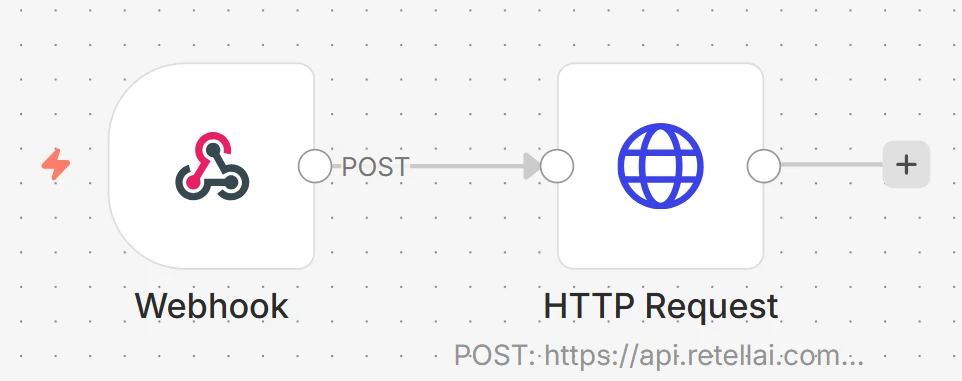
Retell AI + GoHighLevel Outbound Calling Automation
An AI outbound-calling integration connecting Retell AI, GoHighLevel and n8n for lead outreach, qualification and CRM handoff.
 AI Automation
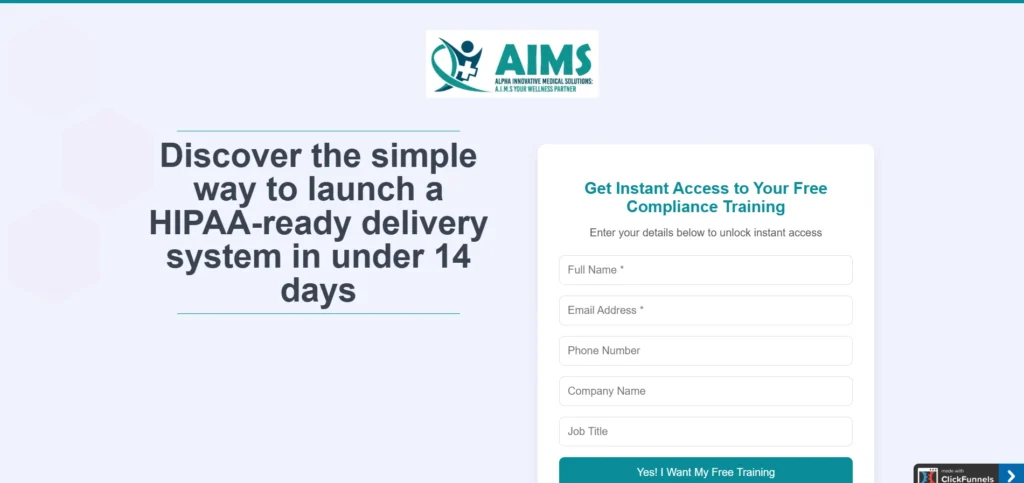
Medical Courier Marketing Funnels & Appointment Automation
An integrated marketing funnel for a medical courier service connecting ClickFunnels, ActiveCampaign, OnceHub and Make.com.
 AI Automation
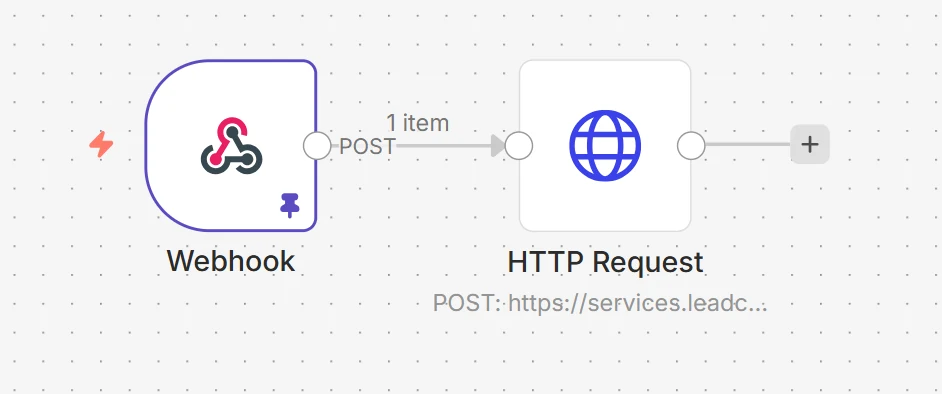
Business Card Scanning to GoHighLevel CRM
A business-card data handoff project involving an existing iPhone scanning workflow, Pipedream and GoHighLevel CRM.